From there Paul's collecting really took off. He became interested in Renaissance bronzes. In a telling interview with Paul Cummings, in 1970, Paul describes his collecting and studying frenzy:
I forget the sequence of events relating to these bronzes: French & Company were moving from 57th Street to their new place uptown. They were liquidating. I just walked in there one day and I saw these Renaissance bronzes for $800, $1,200, $1,600. Well, I just bought them all. I bought about ten pieces. Beautiful bronzes! Beautiful bronzes! One after the other. Two of them were part of the original J.P. Morgan Collection which were published in the big Bota catalogues. I went to Florence to the Bargello and spent weeks and weeks and weeks there where the great collection is, you know, of the Pollaiuolos. Then I went to Modena. Then I went to every Italian city and saw every bronze, every private bronze and every public bronze. In London I went to the Victoria and Albert and spent days and days and days. I went to the Ashmolean to see the Salton Collection of bronzes. I saw all the bronzes. I saw Linsky's bronzes, Untermeyer's bronzes. I saw them all....
When Paul got tired of the Renaissance bronzes he dumped the collection and started anew, this time with American still lifes.
I've had three different still-life collections. I had the great pictures. For instance, today if you were to walk into John D. Rockefeller's apartment at 1 Beekman Place you'll see a great big beautiful table. You walk in, there's nothing here and nothing there and then on this table there's my little picture, my Raphaelle Peale, which is an absolute gem that I bought in the late 1940s or early 1950s. And the Mellons have my still-lifes. And so have the Rockefellers. The Metropolitan Museum has some. That was the first collection I formed and it has been disassembled. And that was a superior collection. A lot of the stuff in the Randenstein book came from me. The Haberle on the cover of Art News was my picture. Mrs. Norman B. Woolworth, a rich lady in Maine, got twenty-two of my pictures through Wildenstein.
One of his most famous collected works was, as Paul mentions, Raphaelle Peale's painting, Blackberries, now in the Getty Museum, a work which I vividly remember hanging in Paul's living room.
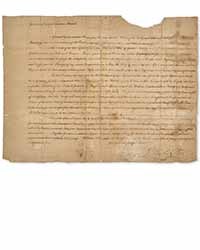
Freeman’s, August 20. President Washington Reaffirms the US Treaty of Friendship and Peace with Morocco, the Longest Unbroken Treaty in US History. $50,000 – 80,000.
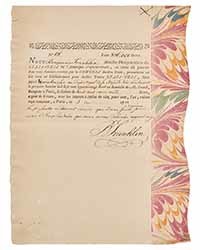
Freeman’s, August 20. Weeks After Victory at Yorktown, Benjamin Franklin Promises Repayment of a French Loan that Funded the American Revolution. $200,000 – 300,000.
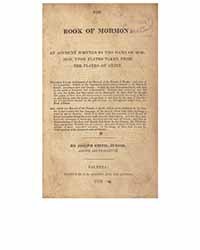
Freeman’s, August 20. Rare First Edition of the Foundational Text of the Mormon Church. $100,000 – 150,000.
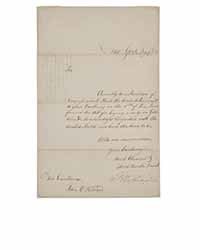
Freeman’s, August 20. President Washington Sends the First Major Law Passed by Congress, the Tariff Act of 1789. $100,000 – 150,000.
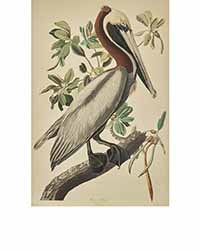
Freeman’s, August 20. A Scarce Example of Audubon's Depiction of a Brown Pelican, Plate CCLI from his Birds of America. $30,000 – 50,000.
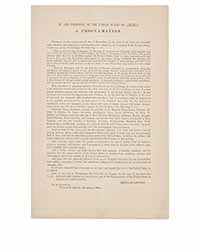
Freeman’s, August 20. The Official and First Obtainable Broadside Printing of the Lincoln's Final Emancipation Proclamation. $30,000 – 50,000.