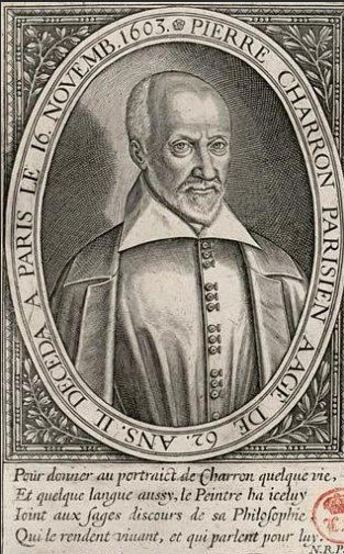
In 1783, Jean-François Bastien put out an edition of Pierre Charron’s De La Sagesse (1) to set the record straight. He argued that all former editions had been incorrect and unfaithful to the first edition of 1601 (Millanges, at Bordeaux). Yet, Charron’s famous book, sometimes said to equal Montaigne’s Les Essais, is closely linked to a powerful Dutch dynasty of printers, the Elzeviers, who published it four times, in 1646, 1656, 1659 (no date), and 1662. According to the bibliophilist Alphonse Willems, (2) « the four editions are well executed, but the 1646 one is unquestionably the nicest one.» But Jean-François Bastien rated none of the Elzeviers’ editions, mostly because they are “incorrect and inaccurate”—so he says.
Pierre Charron (1541-1603) is famous for his friendship with Michel Montaigne, whom he met in Bordeaux, France, around 1589. They became so close that the latter even granted the former the right to use his coat of arms after his death. Jean-François Bastien joined a previously unpublished account of Charron’s life to his book, describing him as “of medium height, plump enough, always joyful and smiling, with a broad forehead, a straight nose getting big at the tip; he had white hair and a white beard, a powerful voice, and a manly vocabulary.” The son of a family of 25 —including 22 from the same mother— Charron received a good education, and soon distinguished himself as a brilliant orator. When in Bordeaux, he published the first version of De La Sagesse. “But Charron was unhappy about the way his book had been printed in Bordeaux,” writes Bastien. “Therefore, he came to Paris in 1603 (...) to work on a new edition.” In fact, Charron felt compelled to rework his book, since some theologians of La Sorbonne had criticized it as a gateway to deism. He asked Denis du Val to print the revised edition, but “never had the opportunity to fulfil his project, meeting his death on Sunday, 16th, November, at the corner of the streets des Noyers and S. Jean de Beauvais, in Paris,” says Bastien. “He was around 62 and a half.” He died from an apoplexy, “having refused to follow the advice of the famous doctor Marescot, who had urged him to be bled.” How unwise!
Soft Wisdom
The first edition of De La Sagesse (Bordeaux) was published by Simon Millanges. Jacques-Charles Brunet, in his Manuel du Libraire (Paris, 1860), describes it as “quite valued”, probably because it contains “various passages that have been suppressed or softened in the 1604 edition of Paris, published after the death of the author (...) by La Roche Maillet, lawyer.” Indeed, the following editions were expunged of a few ideas that had embittered La Sorbonne. “Charron had forethought that the weak and superstitious minds would not welcome his book, and that it would be censored by the presumptuous, the arrogant, the stubborn, (...) who think they know it all, and who consider themselves the wisest men in the world,” writes Bastien. “I genuinely say what I think and believe,” writes Charron. “And I doubt not that the mischievous and the people of low understanding shall bite; but who can avoid it?” As a matter of fact, “the theologians swarmed him at once,” deplores J. Duvernet in his Histoire de la Sorbonne (Paris, 1791), “and he went to the grave surrounded by the chaos of their foolishness and persecution.”
Charron’s first book, Les trois Vérités (1595) was yet a treatise against the Jews, the Muslims and the Heretics—a Catholic manifest, so to speak. But, several parts of De La Sagesse were suspicious to the zealous theologians. Chaudon lists some of them in his Dictionnaire historique (Lyon, 1804): “Charron had written that religions were coming from men, and not from God; he made an exception in his second edition for the Christian one—as required. He had also said that the immortality of the soul was the most spread belief among mankind, and the less demonstrated; and this guilty passage was also softened.” In fact, Charron portrays Man as a sensual creature, who must find God through a natural process rather than through religion. “I want people to be good, independently from any idea of hell or paradise,” he writes. “He was also blamed for putting the following words in the mouth of an atheist: Religion is a wise invention of Man, aiming at maintaining the rabble in their duty,” adds Chaudon. No wonder some libertines claimed his book as their bible. Yet, Charron was just fighting against the hypocrisy of religions, and his book sounds like an appeal to the Christian conscience: “We behave ourselves on the outside, while sending our mind to the brothel.”
He saw carnal love as “a furious and feverish passion that might be dangerous to those who can’t resist it.” At the same time, he wonders: “Why do we talk about the ‘shameful parts’ of Man? Since they are so natural (...), so legitimate and necessary?” As a matter of fact, many copies of De La Sagesse suffer from a recurrent defect: the allegorical engraving bound at the head of the volume has often been darkened. This engraving, absent from the first edition but present in almost every posterior one, represents a naked Wisdom standing on a footstool, peacefully staring at herself in a mirror while holding four women in chains; they stand for passion, superstition, opinion and knowledge. In the background, we can read the author’s motto: I know not, the echo of Montaigne’s What do I know?, and which he had written on the frontispiece of his house, in Condom—yes, where condoms were invented. But some prude readers considered their duty to conceal the ‘shameful parts’ of wisdom.
-----------------------------------------------------------------------------------
1. Of Wisdom. Brunet, in his Manuel du Libraire, writes: “There are two English translations of De La Sagesse; one by Sampson (London, Lennard, 1658), in-4°, with the portrait of the translator, and another one by George Stanhope (London, 1697). »
2. Les Elzevier, Histoire et annales typographiques (Bruxelles, 1880).


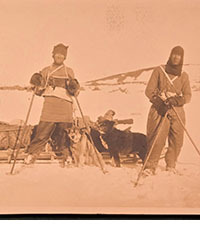
![<b>Scandinavian Art & Rare Books Auctions, Dec. 4:</b> ROALD AMUNDSEN: «Sydpolen» [ The South Pole] 1912. First edition in jackets and publisher's slip case.](https://ae-files.s3.amazonaws.com/AdvertisementPhotos/0a99416d-9c0f-4fa3-afdd-7532ca8a2b2c.jpg "<b>Scandinavian Art & Rare Books Auctions, Dec. 4:</b> ROALD AMUNDSEN: «Sydpolen» [ The South Pole] 1912. First edition in jackets and publisher's slip case.")
![<b>Scandinavian Art & Rare Books Auctions, Dec. 4:</b> AMUNDSEN & NANSEN: «Fram over Polhavet» [Farthest North] 1897. AMUNDSEN's COPY!](https://ae-files.s3.amazonaws.com/AdvertisementPhotos/a077b4a5-0477-4c47-9847-0158cf045843.jpg "<b>Scandinavian Art & Rare Books Auctions, Dec. 4:</b> AMUNDSEN & NANSEN: «Fram over Polhavet» [Farthest North] 1897. AMUNDSEN's COPY!")
![<b>Scandinavian Art & Rare Books Auctions, Dec. 4:</b> ERNEST SHACKLETON [ed.]: «Aurora Australis» 1908. First edition. The NORWAY COPY.](https://ae-files.s3.amazonaws.com/AdvertisementPhotos/6363a735-e622-4d0a-852e-07cef58eccbe.jpg "<b>Scandinavian Art & Rare Books Auctions, Dec. 4:</b> ERNEST SHACKLETON [ed.]: «Aurora Australis» 1908. First edition. The NORWAY COPY.")
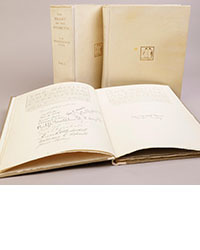
![<b>Scandinavian Art & Rare Books Auctions, Dec. 4:</b> SHACKLETON, BERNACCHI, CHERRY-GARRARD [ed.]: «The South Polar Times» I-III, 1902-1911.](https://ae-files.s3.amazonaws.com/AdvertisementPhotos/3ee16d5b-a2ec-4c03-aeb6-aa3fcfec3a5e.jpg "<b>Scandinavian Art & Rare Books Auctions, Dec. 4:</b> SHACKLETON, BERNACCHI, CHERRY-GARRARD [ed.]: «The South Polar Times» I-III, 1902-1911.")
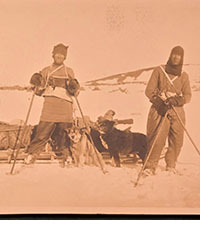
![<b>Scandinavian Art & Rare Books Auctions, Dec. 4:</b> [WILLEM BARENTSZ & HENRY HUDSON] - SAEGHMAN: «Verhael van de vier eerste schip-vaerden […]», 1663.](https://ae-files.s3.amazonaws.com/AdvertisementPhotos/d5f50485-7faa-423f-af0c-803b964dd2ba.jpg "<b>Scandinavian Art & Rare Books Auctions, Dec. 4:</b> [WILLEM BARENTSZ & HENRY HUDSON] - SAEGHMAN: «Verhael van de vier eerste schip-vaerden […]», 1663.")
![<b>Scandinavian Art & Rare Books Auctions, Dec. 4:</b> TERRA NOVA EXPEDITION | LIEUTENANT HENRY ROBERTSON BOWERS: «At the South Pole.», Gelatin Silver Print. [10¾ x 15in. (27.2 x 38.1cm.) ].](https://ae-files.s3.amazonaws.com/AdvertisementPhotos/fb024365-7d7a-4510-9859-9d26b5c266cf.jpg "<b>Scandinavian Art & Rare Books Auctions, Dec. 4:</b> TERRA NOVA EXPEDITION | LIEUTENANT HENRY ROBERTSON BOWERS: «At the South Pole.», Gelatin Silver Print. [10¾ x 15in. (27.2 x 38.1cm.) ].")
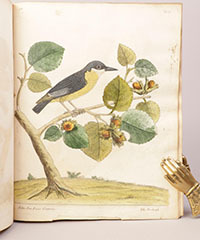
![<b>Scandinavian Art & Rare Books Auctions, Dec. 4:</b> PAUL GAIMARD: «Voyage de la Commision scientific du Nord, en Scandinavie, […]», c. 1842-46. ONLY HAND COLOURED COPY KNOWN WITH TWO ORIGINAL PAINTINGS BY BIARD.](https://ae-files.s3.amazonaws.com/AdvertisementPhotos/a7c0eda0-9d8b-43ac-a504-58923308d5a4.jpg "<b>Scandinavian Art & Rare Books Auctions, Dec. 4:</b> PAUL GAIMARD: «Voyage de la Commision scientific du Nord, en Scandinavie, […]», c. 1842-46. ONLY HAND COLOURED COPY KNOWN WITH TWO ORIGINAL PAINTINGS BY BIARD.")
![<b>Sotheby’s, Dec. 11:</b> Darwin and Wallace. On the Tendency of Species to form Varieties..., [in:] <i>Journal of the Proceedings of the Linnean Society,</i> Vol. III, No. 9., 1858, Darwin announces the theory of natural selection. £100,000 to £150,000.](https://ae-files.s3.amazonaws.com/AdvertisementPhotos/00d5fd41-2542-4a80-b119-4886d4b9925f.png "<b>Sotheby’s, Dec. 11:</b> Darwin and Wallace. On the Tendency of Species to form Varieties..., [in:] <i>Journal of the Proceedings of the Linnean Society,</i> Vol. III, No. 9., 1858, Darwin announces the theory of natural selection. £100,000 to £150,000.")