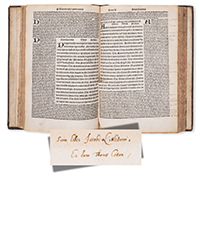
All old Almanacs bear a close family resemblance, which extends to the inferior quality of the paper upon which they are printed. After the title comes an address to the "Kind" or "Courteous Reader." Then appears the conventional, sprawling, disembowelled figure representing the "Anatomy of Man's Body as Governed by the Twelve Constellations," followed by an Ephemeris of the Planets' places for certain days in the month, and then the monthly column of the Calendar begins with spaces left at the top and sometimes at the sides, devoted to reading matter. Frequently only alternate pages are occupied by the Calendar, and the intervening ones are filled with the overflow of wit and wisdom from the spaces, or "vacancies," as Franklin calls them, in the Calendar itself. The pamphlet closes with two or three pages containing sundry items of local interest, tables of distances, rates of duties, and the like. In all Almanacs up to the year 1752, the old style of reckoning was observed, the year beginning on Lady's Day, March 25th.
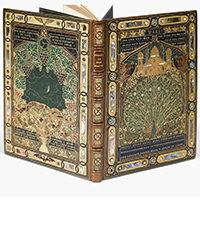
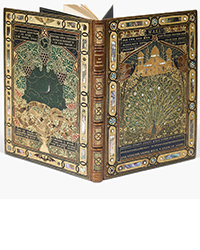
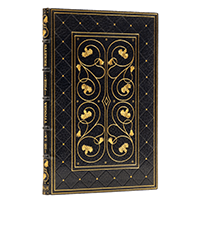
For the convenience of their patrons, the editors of these astronomical diaries provided them with blank memorandum leaves, many of which, covered with the commonplace entries of everyday life, still remain intact and in place. Those who parted with these little books often neglected, either through ignorance or indifference, to remove pages never intended for other eyes than those of the original owners. This is not a matter of surprise either to the bibliophile or the collector of antiquities. Many a treasure which comes to their net uncovers a dead, and to all appearances, discarded past. In the backs of miniatures still lie soft coils of braided hair, and the cover of an old book, with its inscriptions and interlocked emblems and ciphers, is often a poem in leather and gold, replete with romantic interest and full of sad suggestions.
The weather predictions of Philomath, it seems, were more to be relied upon if taken by contraries than literally, if the following story has any foundation in fact, although, to be as honest as the story-teller in the " Legend of Sleepy Hollow," I don't believe one half of it myself.
A noted Almanac maker, wending his way through the country, halted at a farmhouse, and after watering his horse gathered up the reins to proceed on his journey, when he was informed by the attendant that if he went on he would certainly get wet. Glancing at the sky, in which he was unable to discern a cloud the size of a man's hand, he declared that he could see no indication of an approaching storm, and would take his chances. In about an hour the clouds gathered and the rain fell. Impressed with this remarkable fulfillment of the prophecy he had rejected, our traveler retraced his steps to the farmhouse, and offered the wiseacre a half dollar for the secret of his ability to so correctly forecast the weather. "Nothing easier," said he. "We have that old fool's (here he mentioned the name of the man in the wagon) Almanac in the house. For today it foretold fine weather and very dry. So I knew it would surely rain before night."
The line upon line and precept upon precept of these little waifs of books is quaint, old-fashioned literature, but quite as profitable reading now as it was a century ago. We have a sample of its quality in the following extracts from " Poor Richard” and "Hutchin's Improved ":
"I never saw an oft-removed tree,"Avoid going to law, for the quarreling dog hath a tattered skin. It is better to suffer loss than to run to courts, for the play is not worth the candle."
Nor yet an oft-removed family,
That throve so well as those that settled be."
"For age and want save what you may,
No morning sun lasts a whole day."
"It is better to go to bed supperless than to rise in debt."
"Idleness is the key of beggary."
"For the want of a nail the shoe is lost, for the want of a shoe the horse is lost, for the want of a horse the rider is lost."
"Prayer and provender hinder no journey."
"He who looks not before, finds himself behind."
"A penny saved is two pence clear,
A pin a day's a groat a year."
"Cunning differs from wisdom as twilight from open day."
"It is remarkable that death increases our veneration for the good, and extenuates our hatred of the bad."
"Too much of one thing is good for nothing, so we will finish this subject."
We will accept this timely suggestion from John Nathan Hutchins—Philom.—and conclude this article with an "extempore sermon," which was published by the same wise counselor and guide of his fellow-men for the edification of the readers of his Almanac for the year of Grace 1793. If not a perfect model of pulpit oratory, it cannot be denied that it possesses the twin merits of succinctness and brevity:
Preached at the request of two Scholars—by a
LOVER OF ALE,
Out of a Hollow Tree.
Let me crave your attention; for I am a little man, come at a short warning, to a thin congregation—in an unworthy pulpit.
And now, beloved, my text is malt; which I cannot divide into sentences, because it has none; nor into words, it being but one; nor into syllables, because it is but a monosyllable; therefore, I must divide it into letters, MALT. M, my beloved, is moral; A is allegorical; L is literal; and T theological.
The moral is set forward to teach drunkards their duty; wherefore my first use shall be exhortation: M, my masters; A, all of you; L, leave off; T, tippling. The allegorical is when one thing is spoken of, and another is meant; now the thing spoken of is bare malt: M, my masters; A, all of you; L, listen; T, to my text. But the thing meant is strong beer; which you rustics make: M, meat; A, apparel; L, liberty, and T, treasure. The literal is according to the letters: M, much; A, ale; L, little; T, thrift. The theological is according to the effects it works—first, in this world; secondly, in the world to come. Its effects in this world are: In some, M, murder; in others, A, adultery; in some, L, looseness of life; in others, T, treason. Its effects in the world to come are: M, misery; A, anguish: L, languishing, and T, torment. Now to conclude:
Say well and do well, both end with a letter,
Say well is good, but do well is better.