
Rare Book Monthly
Articles - February - 2004 Issue
“Unusual” American Imprints<br>from David Lesser

none
Item 118 is an 1880 message To the Voters of Massachusetts from Samuel Hoar, Chairman of the Massachusetts State Temperance Commission. Hoar’s interest in temperance seems primarily to be an excuse to attack the state’s Irish population. He states that prohibition would be particularly useful to deal with “Irish grog-shops which infest our cities and larger towns.” Hoar goes on to smear the Irish by describing them as “strangers to principle, and accustomed to the dominion of their priests, they can be ruled by law alone.” $150.
Somewhere in between the good and bad must lie item 97, from the Indiana Yearly Meeting of Friends of 1838. This is an Address to the People of the United States, and to the Members of Congress in Particular. On the Civilization and Christian Instruction of the Aborigines of our Country. In it, the Friends acknowledge how the Indians have been removed from their homes and recognize “the debt which they [Americans] owe to this much injured people.” However, their remedy for the wrongs is to extend their concept of “civilization” to this people who “when roused to resentment; they carry on war with indiscriminate slaughter…” $250.
That which is special and good in the American character can be traced to one man in particular. Though he no longer seems to get the press of a Lincoln or Jefferson, no one is more responsible for the character of this nation than George Washington. Kilborn Whitman, in his 1798 Oration…Pronounced at Bridgewater… points out how unusual it was that the Continental Army, rather than asserting its power after the win in the Revolution, simply dispersed. This was based on Washington’s command. Rather than choosing power, Washington turned the government over to a representative democracy. Americans have much reason to be grateful to this man. Item 188. $350.
In 1844, George Collins wrote Fifty Reasons why the Honorable Henry Clay should be Elected President of the United States. By an Irish Adopted Citizen. This was unusual as Clay’s Whig Party had more of the old line British on their side. Irish immigrants, in an affiliation which still to a lesser extent remains today, joined the Democrats. Collins argues that Clay is not anti-immigrant. Unfortunately for Collins, he needed at least fifty-one reasons why people should vote for Clay. Fifty proved insufficient. Clay lost to James Knox Polk. Item 49. $250.
Not all southerners were in a rush to secede. Howell Cobb, who served in various public offices in Georgia and the U.S., and eventually the Confederacy, opposed Calhoun’s rumblings about secession in 1849. He would later serve in President Buchanan’s administration and remain a unionist, almost until the end of his term, when Cobb resigned. Many southerners felt, and rightly so, they could better preserve slavery in their homeland by remaining in the union and cooperating more with the North on other issues. Ultimately, the secessionists prevailed, and as a result, slavery in the South came to an end a few short years later. Item 48. is an address by Cobb headed To Our Constituents in which he lambastes Calhoun. $450.
Rare Book Monthly
-
Sotheby’s
Shelf Life: Books, Manuscripts and Works on Paper from the Library of Stanley J. Seeger and Christopher Cone
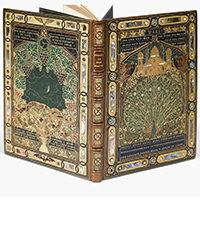
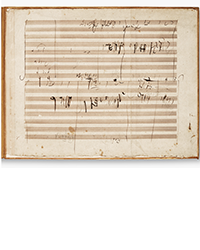
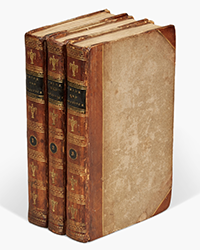
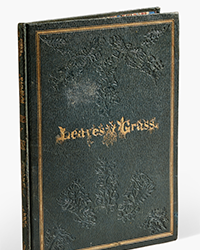
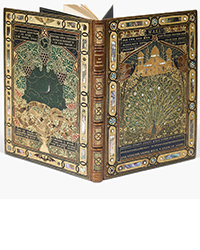
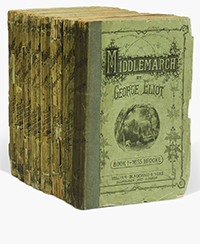
25 June – July 7Sotheby’s, July 7: Ludwig van Beethoven. Autograph sketches for the overture "Die Weihe des Hauses", op.124, [1822], UNPUBLISHED. £150,000 to £200,000.Sotheby’s, July 7: Jane Austen. Pride and Prejudice, 1813, first edition, 3 volumes, contemporary half calf. £50,000 to £70,000.Sotheby’s, July 7: Walt Whitman. Leaves of Grass, Brooklyn, 1855, first edition, first issue, original green cloth, the Doheny copy. £50,000 to £70,000.Sotheby’s, July 7: Binding—Sangorski & Sutcliffe—Omar Khayyam. Rubaiyat, London, 1872, third edition, in a magnificent jewelled Peacock binding. £15,000 to £20,000.Sotheby’s, July 7: George Eliot. Middlemarch, Edinburgh and London, 1871, first edition in the original parts. £20,000 to £30,000. -
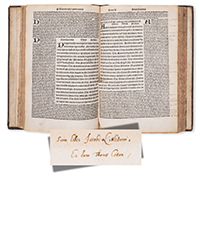
Forum Auctions
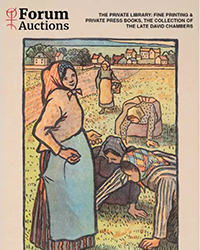
The Private Library:
Fine Printing & Private Press books, the collection of the late David Chambers
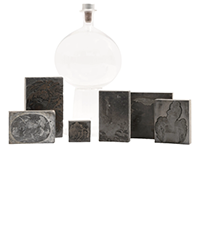
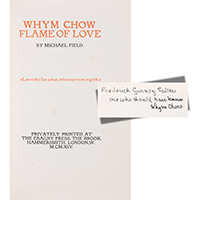
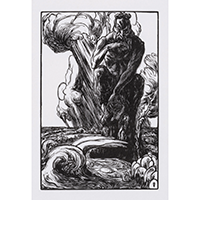
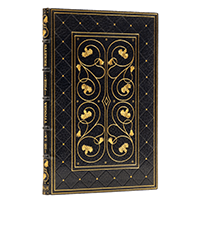
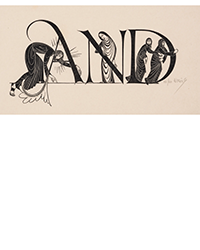
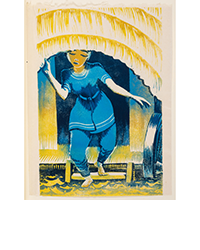
July 9, 2026Forum, July 9: Hassall (Joan) A large collection of over 300 original woodblocks of engravings for various books, v.d., with Hassall's engraver's glass water-globe (Qty) - Est. £10,000-15,000Forum, July 9: Eragny Press.- [Bradley (Katherine Harris) & Edith Emma Cooper], "Michael Field." Whym Chow, Flame of Love, one of only 27 copies, inscribed by Bradley, the rarest book from the press, 1914. - Est. £3,000-4,000Forum, July 9: [Moore (Thomas Sturge)] [Wood Engravings], 71 wood-engravings printed by David Chambers from the original blocks, the only set on Japanese Hosho paper, from an edition of 5 sets, [1970]. - Est. £3,000-4,000Forum Auctions
The Private Library:
Fine Printing & Private Press books, the collection of the late David Chambers
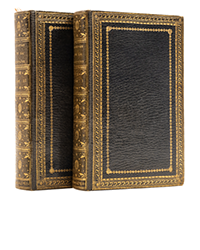
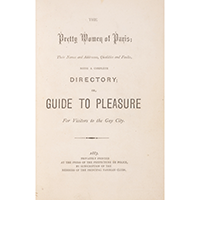
July 9, 2026Forum, July 9: La Fontaine (Jean de) Contes et Nouvelles en vers, 2 vol., engraved plates after Eisen, fine early 19th century blue morocco, gilt, by Bradel l'ainé, Amsterdam [Paris], 1762. - Est. £2,000-3,000Forum, July 9: Erotica.- Prostitution.- Pretty Women of Paris (The); Their Names and Addresses, Qualities and Faults..., [Paris], privately printed at the Press of the Prefecture de Police, 1883. - Est. £3,000-4,000Forum, July 9: Vale Press.- Ricketts (Charles) & Lucien Pissarro. De la Typographie et de l'Harmonie de la Page Imprimée…, [one of 216 copies], bound in dark blue morocco tooled in gilt, by Sarah T.Prideaux, 1898. - Est. £1,000-1,500Forum Auctions
The Private Library:
Fine Printing & Private Press books, the collection of the late David Chambers
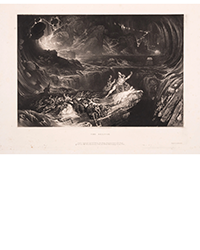
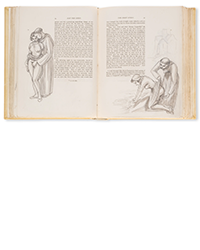
July 9, 2026Forum, July 9: Martin (John) Illustrations of the Bible, complete set of 20 mezzotints, good impressions, rarely found in early states, [c.1831-1835]. - Est. £1,000-1,500Forum, July 9: Golden Cockerel Press.- Four Gospels of the Lord Jesus Christ (The), one of 500 copies, Mary Gill's copy, Waltham St. Lawrence, 1931 with a signed proof of engraving on japon numbered 10/10 (2) - Est. £5,000-7,000Forum, July 9: Boccaccio (Giovanni) The Decameron, 3 vol., vol.1 extra-illustrated by John Buckland Wright with c.150 erotic original drawings in pen & ink and pencil, 1886 [extra-illustrated c.1940]. - Est. £10,000-15,000Forum Auctions
The Private Library:
Fine Printing & Private Press books, the collection of the late David Chambers
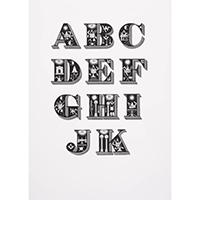
July 9, 2026Forum, July 9: Cox (Morris) Collection of Gogmagog Press Books, 35 vol., rare complete collection of printed books issued by the press, limited editions, most signed by Cox, 1957-83. - Est. £10,000-15,000Forum, July 9: Wynkyn de Worde.- [Terentius Afer (Publius)] [Comedie...], [Paris, Josse Badius: sold in London by Wynkyn de Worde, & others], [15 July 1504]. - Est. £4,000-6,000Forum, July 9: Mosley (James) Ornamented Types. Twenty-Three Alphabets from the Foundry of Louis John Pouchée, 2 vol., one of 10 copies for presentation, from an edition of 210, 1992-93. - Est. £1,000-2,000 -
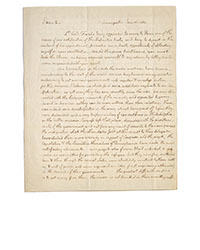
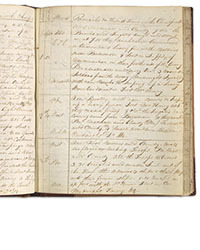
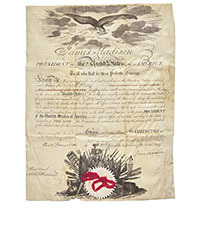
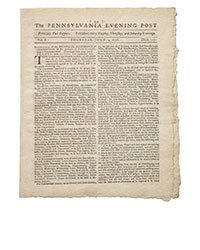
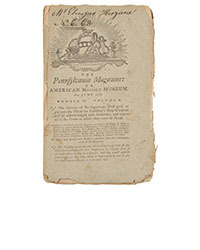
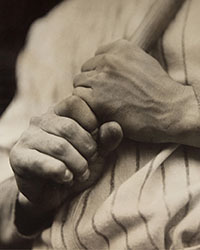
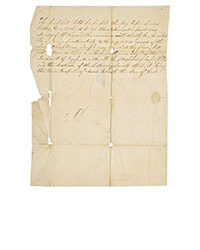
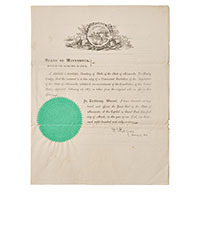
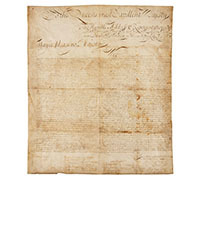
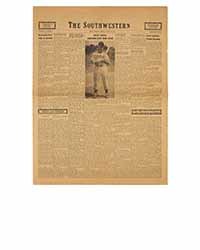
 Freeman’s, June 30. Thomas Jefferson’s “Birth of the New Nation” letter, carried to Paris with the Treaty of Peace, by a Jewish patriot. $100,000-200,000.Freeman’s, June 30. “The rockets’ red glare.” A British midshipman’s log recording the bombardment of Fort McHenry. $60,000-80,000.Freeman’s, June 30. The Critical Promotion of a Naval Hero, Oliver Hazard Perry Commission signed by James Madison, 1812. $40,000-60,000.Freeman’s, June 30. Born in the USA: First Day of Printing in the United States, July 4, 1776. $15,000-25,000.Freeman’s, June 30. One of the Earliest Printed Announcements of American Independence, in the Exceedingly Rare Original Wrappers, 1776. $10,000-15,000.Freeman’s, June 30. "The Two Big Guns of the N.Y. Yanks": A Striking Type 1 Press Photograph of Lou Gehrig's Hands. $8,000-12,000.Freeman’s, June 30. A Unique Contemporary Manuscript Account of Joseph Smith's Final Words to His Followers, the Day Before his Violent Death. $8,000-12,000.Freeman’s, June 30. The State of Minnesota Officially Certifies the Fourteenth Amendment to the Constitution Of the United States. $8,000-12,000.Freeman’s, June 30. Extraordinarily Large Manuscript Petition Signed by a Who's Who of Colonial New York to Queen Anne from the Colony of New York. $8,000-12,000.Freeman’s, June 30. Mickey Mantle's First Cover: The Earliest Front-Page Newspaper Image of Mickey Mantle, "Something Good from Joplin". $8,000-12,000.Freeman’s, June 30. A Call to Arms in the Months Following the Declaration of Independence: An Early Continental Army Recruitment Poster. $6,000-9,000.Freeman’s, June 30. Samuel Jones, the Statesman Behind the Newly Discovered "Jones Declaration": His Annotated Set Used in His Working Law Library. $6,000-9,000.