A Summer Medley from Zephyr Used & Rare Books
- by Michael Stillman
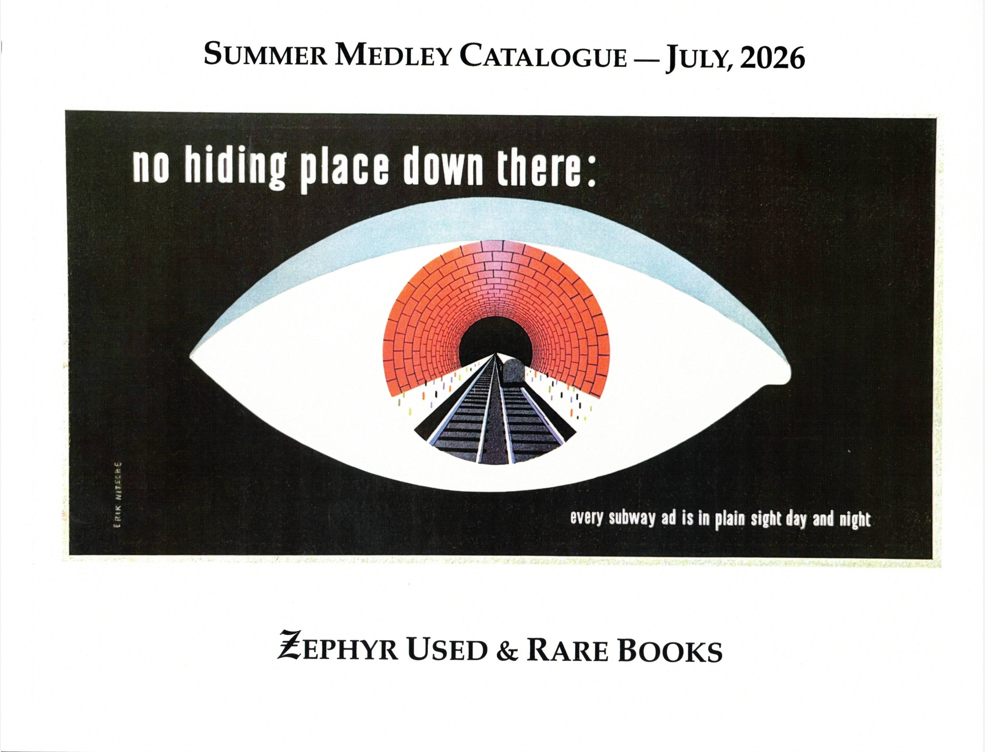
A Summer Medley from Zephyr Used & Rare Books
Zephyr Used & Rare Books has created a Summer Medley Catalogue. It would be appropriate for any season, but it just happens that this collection was put together during the summertime. Zephyr notes that "...summer gives us visions of reading great books," but so do winter, spring and fall. So, as summer gives way to fall, this will still be great catalogue. Here are a few selections.
This one is Brown's Political History of Oregon. Treaties, Conventions, and Diplomatic Correspondence of the Boundary Question... The author was J. Henry Brown. Published in 1892, Zephyr says this is a first edition of what is considered one of the rarest histories of Oregon. Most of the copies were destroyed in a fire, others lost at sea. Soliday and Eberstadt believed only 20 copies survived, but there are now 30 listed in WorldCat. No copies have been listed in auctions or dealer catalogues in over 50 years. The book used a large number of documents, covering overland immigration records and maneuverings of the early Territorial government. Of notable interest is a manuscript note telling the story of an early pioneer woman. It says she told a story of a woman crossing the plains and "being out of provisions, having to eat dog meat and this woman said she thought this was awful, but, she sed we even had to do worse...they had recourse to dried salmon that had maggots in it....After she ate it she got down on her knees and prayed for more dog." Item 120. Priced at $1,250.
You might not be surprised at anything today, but you would think that during the World War II era and the greatest generation, everyone would have pulled together to help the war effort and the airmen. Wrong. Here is Rent Investigation: Rent Conditions in Clovis, New Mexico. Albuquerque and Clovis, NM: Office of Price Administration, August 10, 1943. Emergency price controls had been passed in 1942, but some landlords, and many may better be described as slumlords, ignored the rules. This typescript report on housing available includes 81 mounted photos of local housing. The report says 75% of the homes did not have electricity, 40% lacked indoor plumbing. Nevertheless, rents had been illegally raised 4 to 10 times the pre-war rates. The report says most landlords in Clovis opposed rent control and organized against it. One apartment contained 12 2-room apartments which could be sold as 24 1-room apartments. Construction was poor, furnishings scant, no electricity or gas connections. "One outhouse and shower is used by 14 families." Other issues included unvented gas stoves, no fire exits, cardboard boxes used as construction materials. Twenty-four cases of polio were reported. "...the level of filth and decay was nauseating to the investigator." Another landlord put trailers on blocks and parked them on city sidewalks. The violations were even worse for housing rented to "Negro" or "Colored" airmen. Such were the conditions faced by the airmen and their families from Clovis Airbase (now Cannon Field). Item 101. $1,550.
Next is a cigarette card collectors' photo album of images of the voyages of the Graf Zeppelin. Published in 1933, the images cover such events as voyages over the Arctic polar ice, flights over the Soviet Union, including aerial views of Leningrad, Rome, North Africa, Palestine, Sweden, Norway, Denmark, Iceland, Switzerland, Austria, Spain, and Germany. The Graf Zeppelin would go on to do numerous transatlantic passenger flights. What is also seen is some Nazi government markings after the Nazis came to power in 1933, including a flight over the Nazi May Day celebration in 1933. A portrait of Hermann Goering is also seen. He would take over the company as the Nazis forced the private operators out of the way. It flew only once more after the Hindenburg disaster and Goering ordered it scrapped in 1940. Item 20. $375.
Item 62 is a collection of fifteen 21 x 11 4-color streetcar advertising signs. They date from 1914-1932. These were placed in California streetcars and trolleys. They were produced for Street Railways Advertising Co., the world's largest such company at the time. They were designed to fit in frames located on the streetcars, which could readily fit another advertiser's card when the advertising contract expired. Sunkist was a major advertiser. They had cards telling people, "Tea is not correct without Lemon...Sunkist Lemons." There was "Cooling healthful Sunkist Lemonade," and "Amazing bargains in Sunkist oranges." They also had one that proclaimed "Say Sunkist for Cocktails." Before you get the wrong impression, they were talking about grapefruit cocktails, not the other kind. There is also "Del Monte World's Food Fair at Grocers' everywhere - Now! Featuring some of the lowest prices in Del Monte history." Then there was Lucky Strike cigarettes. I don't think they were entirely honest. Their placard announces, "TOASTING expels Certain Harsh Irritants!!"A man through a bubble caption proclaims, "They're out so they can't be in!!" Continuing with the inaccuracies it says, "Luckies are always Kind to your throat," and "Your Throat Protection - against irritation against cough." Luckies were harsh, and that's before getting into what they did to your lungs. $1,950."
This one is Alfred Hitchcock Presents Stories they wouldn't let me do on TV, published in 1957. Alfred Hitchcock is best known for his many suspense movies for which he earned six Academy Awards. He is regarded as one of the greatest filmmakers ever. Hitchcock also did suspense stories on TV from 1955-1965. That was also called "Alfred Hitchcock Presents." On the cover of this book is the famous line-drawing of Hitchcock's profile that was also seen with the credits on his TV shows. Item 29. $200.
Zephyr Used & Rare Books may be reached at 360-695-7767 or [email protected].