David M. Lesser Fine Antiquarian Books Offers a New Catalogue of Rare Americana
- by Michael Stillman
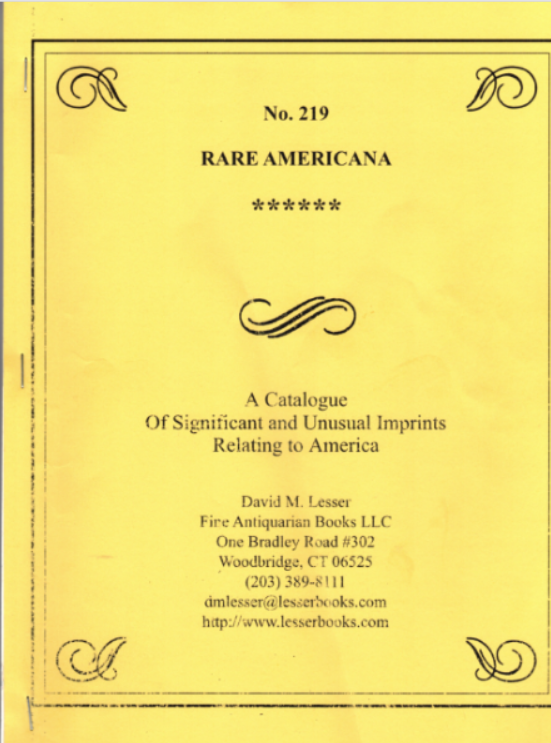
David M. Lesser Fine Antiquarian Books Offers a New Catalogue of Rare Americana
David M. Lesser Fine Antiquarian Books is offering a new selection of "significant and unusual imprints relating to America." This one is Catalogue 219. The format is the same as the many catalogues that preceded it. Only the items being offered have changed. That's what matters anyway, so here are a few of the items included in this latest collection. They are different, yet similar, to what they have offered through the years.
We begin with a document whose importance might not be immediately obvious. It indirectly pertains to America's "original sin," slavery and racism. Dated March 8, 1813 (during the War of 1812), it is a District Port of Philadelphia. List of Persons. Specifically, it is one that states, "I Henry Rihl do solemnly, sincerely, and truly swear that the within list contains the names of the crew of the Schooner Dart together with the places of their birth and residence, as far as I can ascertain the same." Descriptions are provided for the seamen, including place of birth, country of citizenship or residence, age, height, complexion, and hair. Those last two can give away an important feature, as five were listed as Black and one Mulatto. This ship was headed to Virginia, a slave state. Black sailors risked being taken into slavery in southern ports by claiming they were runaway slaves. This provided Black sailors with some protection in southern states, though risk remained high. Some states passed Negro Seamen Acts which sought to override federal protection for Black seamen. Item 14. Priced at $3,500.
For some unfathomable reason, the southern states kept re-litigating the issue of race long after slavery was abolished. This is an appeal by the state of Alabama concerning desegregation of schools: In the Supreme Court of the United States, October Session, 1967, Governor Lurleen Burns Wallace in Her Capacity as Governor of the State of Alabama and as President of Alabama State School Board of Education...vs. United States of America. Earlier that year, a court had ordered Alabama to "stop discriminating on the basis of race in operation or the conduct of the public schools of Alabama, or in any manner pertaining to the public schools of Alabama. Said defendants shall take affirmative action to disestablish all state enforced or encouraged public school segregation and to eliminate the effects of past state enforced or encouraged racial discrimination in their activities and their operation of the public school systems throughout the State." Alabama could not bring itself to stop, so thirteen years after Brown vs. Board of Education ordered an end to school segregation, Alabama was still fighting reality. Alabama appealed this decision to the U.S. Supreme Court. This is the brief Alabama filed with the Supreme Court in its attempt to overturn the lower court's ruling. The Supreme Court affirmed the lower court's order without seeing need to further explain the obvious decision. The petitioner in the action, Gov. Lurleen Wallace, was the wife of former and more famous/infamous Governor George Wallace. When he was prevented from seeking reelection due to term limits, he had his wife run (successfully) to succeed him as Governor. Item 2. $500.
Bathsheba Spooner was a first American, a dubious honor which she undoubtedly regretted. Bathsheba Spooner was the first American woman post-Declaration of Independence to be executed. Bathsheba was married to Joshua Spooner, an older, well-off farmer. It was an arranged marriage and one that obviously was not to Bathsheba's liking. What was to her liking was young soldier Ezra Ross. She became pregnant, courtesy of Ross, and figured the solution to her problem was to off her husband. She enlisted Ross and two others to perform the heinous deed to solve her problem. They succeeded, but soon thereafter, things went downhill for Mrs. Spooner. They were quickly found out. Justice was swift in those days. They were convicted and three months from the murder, Bathsheba, Ross, and two helpers were executed. Even before the final curtain was drawn, the sordid tale made it to print. Here is one of those booklets, by Nathan Fiske - A Sermon Preached at Brookfield March 6, 1778. On the Day of the Interment of Mr. Joshua Spooner, Who Was Most Barbarously Murdered at His Own Gate, on The Lord's Day Evening Preceeding [sic], by Three Ruffians, Who Were Hired for the Purpose by His Wife. Fiske says, "So premeditated, so aggravated, so horrid a murder was never perpetrated in AMERICA and is almost without parallel in the known world." Item 41. $2,500.
Sam Houston enjoys a good reputation today. He is remembered for his role in Texas independence, leading to its joining the Union. He was popular in Texas, but less so near the end of his life. He was okay with slavery, and owned slaves, but he was against secession. He believed it was in the best interests of Texas to remain in the Union, a view not shared by many Texans in 1860. He was forced out of the governorship in 1860, but refused aid from the federal government to remain in office. He believed the "Lost Cause" was a lost cause. Houston would have welcomed a run for the presidency, and had some supporters, but never enough to convince him throw his hat in the ring. However, he was President of the Republic of Texas, and governor after statehood. Item 49 is Life of General Sam Houston, published by supporters in 1856. It covers his life, from beginnings in Virginia to his political leadership in Tennessee and Texas. Its influence, if any, was not sufficient to make Houston a serious presidential candidate. Item 49. $350.
Item 96 is a lithograph of a horrible tragedy that occurred on December 11, 1811. There was a terrible fire at the theater in Richmond, Virginia. Seventy-two people died, including a former senator and the recently elected Governor of Virginia. This hand-colored lithograph depicts the awful scene, flames shooting from the building, people jumping from the windows and running from the fire. You can see the terror on their faces. The fire started when a lit chandelier was lifted between scenes, lighting some of the scenery and roof. Attendees were not immediately aware of the fire as it started behind drawn curtains. Some were trapped after staircases collapsed. The lithograph was created by Benjamin Tanner. Item 96. $1,500.
David M. Lesser Fine Antiquarian Books may be reached at 203-389-8111 or [email protected]. Their website is www.lesserbooks.com.