A New Selection from David M. Lesser Fine Antiquarian Books
- by Michael Stillman
A New Selection from David M. Lesser Fine Antiquarian Books
David M. Lesser Fine Antiquarian Books has published a new catalogue of rare and antiquarian Americana. This one is number 218. Their catalogues come out frequently, as they regularly update the material available. The books and ephemera are old, mostly 19th century and older. The politics and medical advice often is dated, and yet, some of it sounds like it was written today. Sometimes we don't advance that quickly. Here are a few selections from this month's new catalogue.
It was the South's last and best chance to deal with the issue of slavery before it led to its inevitable bloody conclusion. After Nat Turner's rebellion, some whites began to realize slaves were not the only ones at risk. In Virginia, Charles Faulkner and Thomas Jefferson's grandson, Thomas Jefferson Randolph, brought a proposal to the Virginia legislature. It provided for gradual abolition so as not to disrupt too greatly the operation of plantations. Under this rule, promoted in 1832, the children of slaves born after July 4, 1840, would be free. This is The Speech of Charles Jas. Faulkner, (of Berkeley) in the House of Delegates of Virginia, on the policy of the State with Respect to Her Slave Population. Delivered January 20, 1832. Faulkner attempts to win over his white audience by explaining this "evil" "banishes free white labor-- it exterminates the mechanic-- the artizan-- the manufacturer...It converts the energy of a community into indolence-- its power into imbecility-- its efficiency into weakness. Sir, being thus injurious, have we not a right to demand its extermination? Shall society suffer, that the slave-holder may continue to gather his crop of human flesh?" Faulkner and Randolph made a good run, but the slave power controlled the legislature. The measure was defeated by a margin of 73-58. Item 54. Priced at $1,500.
Joseph Huntington provided one of the most eloquent explanations and justifications of the American Revolution after its conclusion. This is God Ruling the Nations for the Most Glorious End. Huntington was a Connecticut pastor in 1784 when he delivered these words, "When a British King became a tyrant, and the Parliament a band of despots, and would be content with nothing less than to bind a great part of the empire in chains of perpetual slavery...When they plunged their daggers in the breasts of an innocent people, and called upon us the savages of the wilderness, with all their infernal massacres, our feelings were greatly changed. We once loved Britain most dearly; but Britain the Tyrant, we could not love; our souls abhorred her measures; when matters were pushed thus far, we desisted from all our humble prayers to deaf ears and unrelenting souls. We rose from the dust where we had long been prostrate-- our breaths glowed with noble ardor-- we invoked the God of our fathers, and we took the field." There really isn't much more that needs to be said, although the "savages of the wilderness" comment displayed some fundamental misunderstanding of those more downtrodden than even they were. Item 78. $450.
Here are some more words of wisdom from an 18th century American pastor. John Barnard served a church in Andover, Massachusetts, 30 years before the Revolution. Maybe if his distinguished guests had paid more attention to his words, the Revolution might not have been necessary. Item 11 is The Presence of the Great God in the Assembly of Political Rulers. A Sermon Preached before his Excellency William Shirley, esq.; Governour; the Honourable his Majesty's Council; and the Honourable House of Representatives of the Province of the Massachusetts-bay in New-England, May 28th. 1746. Barnard tells his guests, "For one Person alone to have the Government of a People in his Hands, would be too great a Temptation. It tends to excite and draw forth the Pride of Man, to make him unsufferably haughty; it gives him too much Liberty to exert his Corruptions; and it encourages him to become a Tyrant and an Oppressor." It has been almost three centuries since he spoke, and yet it feels like Barnard's words could be as important today as they were in his time. Item 11. $500.
This is a rare edition, even rarer for being a complete copy. It was written by a man who knew a lot of words, Samuel Johnson. The title is The History of Rasselas, Prince of Abissinia, as Asiatic Tale. The Prince lives in a happy world, but becomes bored. He strikes out to see the world, but finds nothing better and returns home. A few things happen along the way. This first American edition is known in only 12 copies and most of those lack the frontispiece and Johnson's final three pages. The title page carries the odd notation, "Printed for Every Purchaser." I guess Johnson didn't want to single out anyone in particular for whom to dedicate the book. Item 81. $45,000.
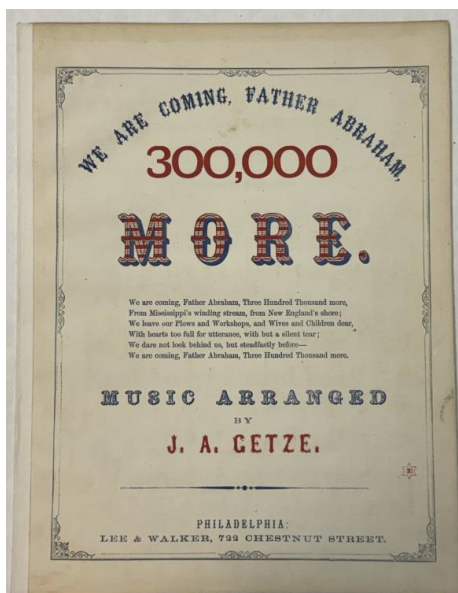
From the middle of the Civil War comes this patriotic song, We Are Coming Father Abraham 300,000 More. This is the sheet music, as arranged by J. A. Getze. While often attributed to William Cullen Bryant, the lyrics were actually written by James Sloan Gibbons. This was a popular tune in 1862, at least in the North. Lincoln had called for an additional 300,000 volunteers as the war dragged on longer than expected.
"We are coming, Father Abraham, 300,000 more,
From Mississippi’s winding stream and from New England’s shore.
We leave our plows and workshops, our wives and children dear,
With hearts too full for utterance, with but a silent tear."
The chorus concludes,
"We are coming, we are coming our Union to restore,
We are coming, Father Abraham, 300,000 more!"
A true oldie but goodie. Item 86. $450.
David M. Lesser Fine Antiquarian Books may be reached at 203-389-8111 or [email protected]. Their website is www.lesserbooks.com.