Convictions Obtained for Six Thieves Who Stole Millions of Dollars Worth of Books from European Libraries
- by Michael Stillman
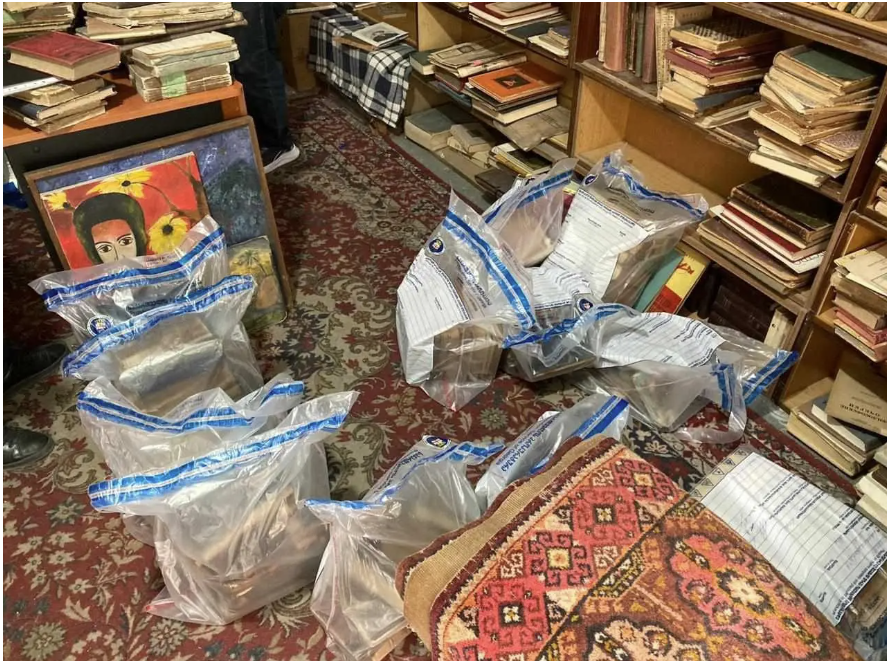
Europol photo.
They showed up at libraries across Europe. They presented themselves as scholars and researchers. Their topic of interest was historic Russian literature. They presented their IDs and library cards and asked to see first editions and other historically important old Russian works. Pushkin, Gogol and Lermontov were favorites. The “scholar” might be working on a thesis or research project. All seemed in order. The librarians would bring the requested materials, but because of their importance and high value, some would watch the visitors to make sure they acted properly.
The researchers would carefully measure and photograph the works. Such details are important for in depth study of old books. They then returned the books, said their goodbyes, and left. Everything was in order.
However, when they returned home, they did not begin to study their notes and photographs to write a research report. Instead, they were given to a master forger who was part of the group to create fake copies. He was very good. Few people would have recognized they weren't real, at least not without a careful and expert inspection. Several months later, they would return to the library, fakes hidden on their person. They would ask to see the books again. This time, they surreptitiously pulled out the fakes they had hidden and replaced the real books with them. The real books went into their hiding place. Then, they would bid adieu and leave again.
The real books appear to have mostly ended up in Russia where many were sold at local auction houses. It has been estimated that something like $2.5 million worth of books were stolen from French libraries alone this way. There is deep suspicion that the Russian government was involved in this as it has been highly interested in bringing Russian cultural objects back to Russia. High moral standards is not something associated with the Russian government.
As the forgeries were very good, it took almost two years for the them to be discovered. After a few discoveries, other libraries began to check out their historic Russian collections. Europol was called in to investigate. It turned out these were coordinated thefts on a massive scale. Countries whose libraries may have been targeted include France, Germany, The Netherlands, Switzerland, Czechia, Poland, Finland, Lithuania, Latvia, and Estonia. They then had to locate the guilty parties. The IDs and library cards they presented were also forged. However, they did manage to find their suspects and trials have started in some of these countries, with convictions already obtained.
Recently, a trial was held in France with verdicts issued on June 13. Books were stolen from the National Library of France, the University Library of Languages and Civilizations in Paris, and the Diderot Library in Lyon. Six individuals, all from Georgia (the country), were convicted, two in absentia (they were detained in Georgia but there is no extradition treaty). They were convicted of criminal conspiracy to commit an offense, with some also convicted of theft of cultural assets. The heaviest penalty went to Mikheil Zamtaradze, 50, the ringleader of the group. He received seven years in prison. This was on top of a sentence of three years and four month imprisonment for similar crimes committed in Lithuania. Next was a sentence of four years issued to Beqa Tsirekidze, 49. He too had a previous conviction and sentence, three years and six months in prison in Estonia. Members of these two families were also participants in the crime ring. Others received lesser sentences, the lowest being six months suspended.
That does leave one unanswered question and here the news is not so good. Will the books be returned? So far, none of them have been. Authorities are very pessimistic they ever will be. Cooperation with Russia, where the books are believed to be located, is nonexistent. One was identified at high-end auction house Litfond. The auction house claimed it was a Russian owned copy and refused to return it. The Russian government has wanted to bring Russian cultural objects to Russia, and this is consistent with their wishes. A nation engaged in attacking and killing its neighbors is not one likely to be swayed by such details as property ownership. Neither authorities nor the libraries have any great hope the books will be returned, even if for the record they say they have not given up hope. Hope is not a strategy.