Book Drenching, the Latest Trend
- by Michael Stillman
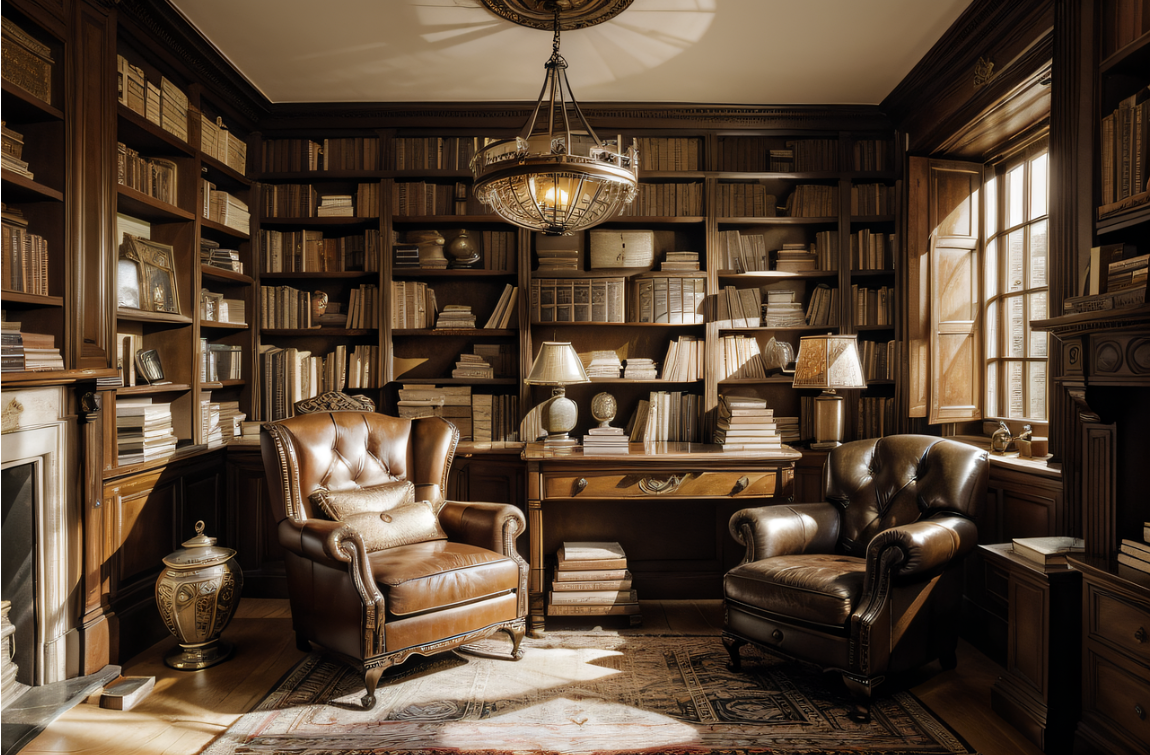
A room drenched in books.
There is a new interior design fad out there that pertains to books, but doesn't require you to go through the laborious procedure of reading them. It's called “book drenching,” and no, it doesn't require soaking your books in water and destroying them either. The books are the drencher, rather than the drenchee. Instead of the books being drenched, it involves books drenching your space. A better word than “drenching” surely could be applied. An alternative name sometimes used is - “library wrap.” That sounds sort of better.
Here is what book drenching is. It's a room with bookcases filled with books, all over the room. Ideally, they are floor-to-ceiling bookshelves, every shelf jammed full of books. The room itself should have bookcases covering every wall. If that doesn't show your undying love for literature, nothing will. This is the ultimate statement.
No particular order is required on the shelves. They don't have to be arranged by color as has been a fad. They don't have to match by size. They don't have to have the spines out or in. They can be mixed. They don't even have to rest on the tail or bottom of the book. They can lie flat, or be a mix. The purpose is not to show your sense of order. It's to display your love for books.
This is very different from arts of the book. In the book arts, each book is something special. Covers usually make an artistic statement. Not so for book drenching. There is no book individuality here. The books are meant to blend into a whole, perhaps ordered, perhaps disheveled as long as they're shelved. They live for the whole, not themselves, like an ant in an anthill, or a communist factory worker. They are each a dot in a halftone. The books are a tapestry. Alone, the books are nobody, but together they become a work of art.
If there is something in the practical world this resembled it would be the great libraries once owned by the Pierpont Morgans of the world. They were huge libraries but, at least to some extent, they were working libraries, not just a fashion accessory. Book drenching requires no particular appreciation for the individual books themselves, just a desire to create a work of art that implies you appreciate literature in general.
Not entirely understanding the concept, I turned to Form & Taste to better explain. They say, “Beyond the simple act of storage, the concept of 'book drenching' in interior design re-imagines the role of literature within our homes. It poses a question: what if a collection of books could be more than an accessory and instead become the primary finish of a room? This approach moves past the curated bookshelf, proposing an immersive experience where books function as a fundamental architectural surface, akin to paint, tile, or wallpaper.
“The idea is not merely to display books, but to use their collective mass to define a space. It is a visual and tactile strategy that leverages the inherent qualities of the book as an object—its color, texture, and form—to create a powerful aesthetic statement. This shift in perspective treats books not just as vessels of information but as modular building blocks for creating atmosphere.”
Continuing, “it is not about a few neatly arranged stacks or a well-ordered shelf; it is about scale and density. The objective is to achieve a critical mass where the books cease to be individual items and merge into a unified visual field.”
I'll admit I never thought of books as paint or wallpaper. I doubt that Gutenberg did either. There seems to be something missing, like what books are all about. It feels more like a new fad that is likely to have, so to speak, a limited shelf life. Not long ago, the thing was “bookshelf wealth.” This design burst onto the scene two years ago. Described as “artful clutter,” it featured bookshelves jammed with books, but also other things. Various trinkets and other objects are placed on the shelves. These are things that are supposed to have personal meaning to the owner, perhaps gifts or things collected on trips. And before this, there was color coding where people would buy books “by the foot” in one color so they could have a shelf full of red books, and maybe one of blue books too.
Missing from all of these is what is inside the books. Their historic purpose, that brought the world from the Dark Ages into the Renaissance, is missing. The printed word has become irrelevant. The knowledge is gone. It has become beauty without meaning.