Marcel Duchamp - Still Making Waves
- by Susan Halas
Marcel Duchamp continued to make waves at an April 23rd auction at Phillips in NYC, where 105 lots of his work and pieces by other artists influenced by him were offered.
Results of influential auction at Phillips April 23 curated by Francis Naumann
For an artist who was only 25 when he first came to American notice in the 1913 NYC Armory Show, Marcel Duchamp certainly proved to have staying power. For over a hundred years he was able to infuriate, irritate, amuse and redefine what we mean by “art.” Duchamp, who began his career as an enfant terrible back then, is still causing a ruckus more than 100 years later.
The historic Armory Show included many American artists and it also provided the first chance for Americans to see the work of people like Van Gogh, Matisse and Gauguin. While these and other European artists were well regarded abroad, Americans found them shocking. And no one was more shocking than Duchamp, with four pieces in the exhibit.
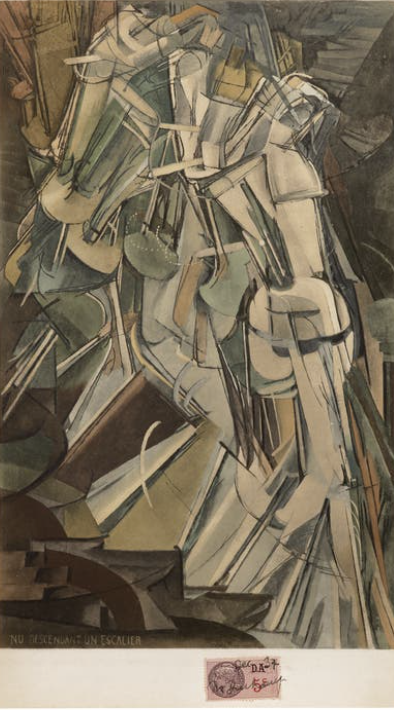
Reaction to his large painting Nude Descending a Staircase, dubbed by some critics, “Explosion in a Shingle Factory,” eclipsed everything else. It was seen by an estimated 87,000 New York art lovers who tramped through the Armory. It became famous (and infamous) as an aesthetic wake-up call that reverberated through the art scene both then and now.
Not content to rattle Americans with a nude that didn’t look like a nude, Duchamp next introduced his famous “ready-mades” including the porcelain urinal signed R. Mutt 1917, followed by a variety of other conceptual pieces based on bicycle wheels, dish racks and other oddball contraptions, likely to be mishmashed together.
These works mystified and unsettled both the general public and the art establishment. Most people who saw them did not embrace his Dada/Surrealist view that anything could be art, much less his wider pronouncement,” It’s art if that’s what I call it.”
All of that is just a roundabout introduction to the Duchamp show at NYC’s Museum of Modern Art through August and the "Duchamp & Company" auction recently hosted by Phillips on April 23, also in Manhattan. The sale included 110 lots, of these 48 lots were by Duchamp and 62 were examples by his contemporaries and those he inspired such as Man Ray, Robert Rauschenberg, Richard Pettibone, Mike Bidlo, Sherrie Levine, John Baldessari, and Joseph Kosuth.
The Phillips event was curated by Francis M. Naumann, 78, an art historian and dealer, who is a leading Duchamp specialist. Reached by phone Naumann estimated that 75 to 80 percent of the items in the sale came from his own inventory and personal collection, with Phillips supplying the rest.
The Valise
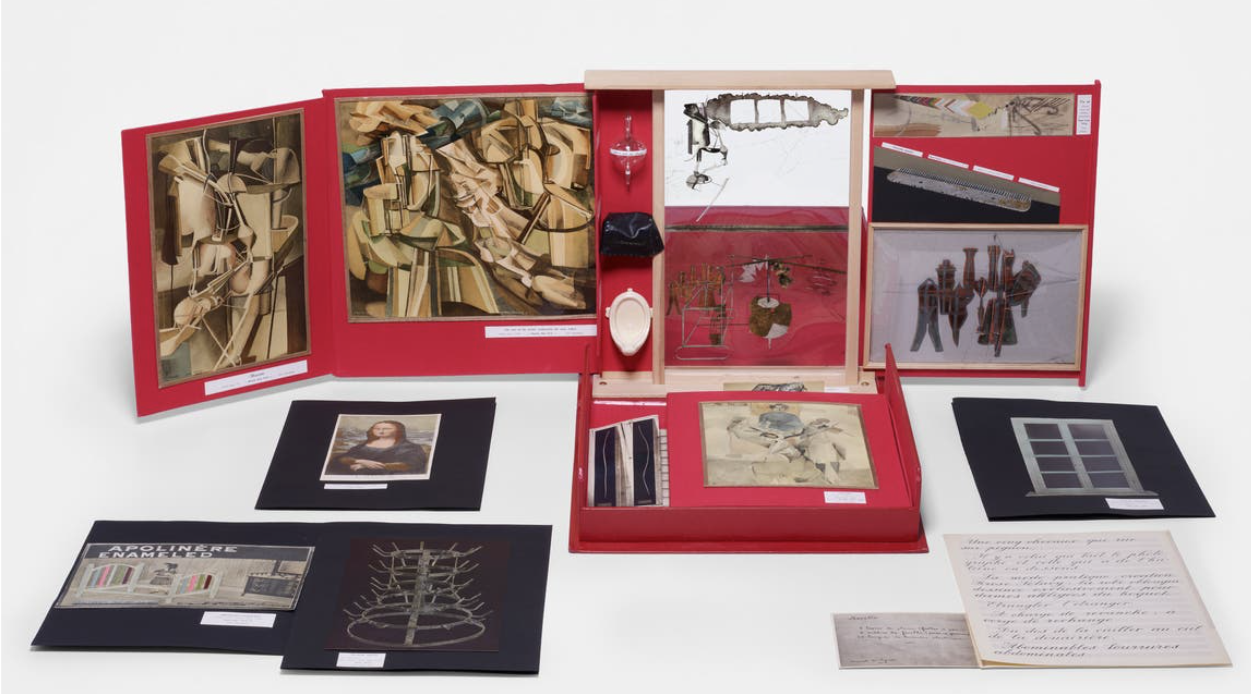
Asked to identify a few of his personal favorites he pointed to the famous Valise, a printed suitcase with all of Duchamp's works in miniature, described in the catalog as: Lot 433, Marcel Duchamp. Full title: De ou par Marcel Duchamp ou Rrose Sélavy (La Boîte-en-valise), série F (From or by Marcel Duchamp or Rrose Sélavy (The Box in a Valise) series F) (S. 484) limited to 300 copies.
https://www.phillips.com/detail/marcel-duchamp/230563
A Valise offered at Christie’s in May 2021 realized $2,070,000. https://www.christies.com/en/lot/lot-6318434 Naumann mentioned a copy that changed hands for $704,000. Phillips put the presale estimate range at $350,000 - $450,000. In the Phillips auction bidding on this item reached $260,000, but did not meet an undisclosed reserve. This item passed (Failed to sell).
Naumann commented that the Valise was assembled in 1966, but the printed contents were produced between 1934-1940. The first 20 were deluxe copies, the remainder were put together as needed over time in different iterations. He described the copy in the Phillips sale as “the red leather version in pristine condition.”
In his catalog notes Naumann wrote, “In 1936, Marcel Duchamp decided to gather reproductions of his most important works for presentation in a modest album, a project that gradually expanded over the years to include 69 separate works of art, not only paintings and drawings, but miniature reproductions of his Large Glass and several ready-mades.
“Eventually, he decided to house these items in a small suitcase, a portable museum of his work that became known as the boîte-en-valise, or when not encased in a leather case, simply boîte.
“Duchamp himself oversaw every aspect of its production, from the execution of the many color reproductions it contains (the majority of which were colored by means of a pochoir or stencil), to the overall design and physical construction of the structure and its contents.
“When the valise is opened for display, the reproductions are exposed to the viewer in a sequential, step-by-step fashion. … Whenever necessity required, Duchamp continued to issue new examples of his valise (until the planned edition of 300 was completed).
“By the mid-1950s, approximately 100 had been assembled and distributed. … Over the years, whenever the need arose, Duchamp had others assembled, but the color and material of the container changed.
“The last version of the valise produced in Duchamp's lifetime was completed in 1966 and differs most notably from those that had preceded it by the use of a striking red leather container.”
Pochoir Print of Nude Descending a Staircase:
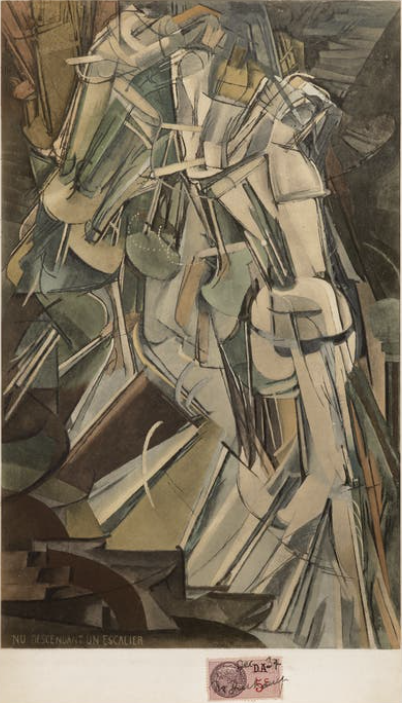
Another Naumann favorite was Lot 462, a signed pochoir of Duchamp’s Nude Descending a Staircase, No. 2 (S. 458) The presale estimate was $60,000 - $90,000.
The selling price was $154,800. This was the top sale at the auction.
https://www.phillips.com/detail/marcel-duchamp/230523
According to Naumann, “During the summer of 1937, as Duchamp was in the process of assembling items for his Boîte-en-valise (see lot 433), he came up with an idea to help fund the elaborate and expensive project: issuing five hand-colored pochoir stencil prints of select paintings that would be included in the work. In the end, he produced only two: one of his famous Nu descendant un escalier and another of his Mariée.
“Three hundred were made for inclusion in the valise and 205 more were made and sent to the American art dealer Julien Levy. All of these pochoirs were signed but not numbered, each to be sold for one dollar.
“Levy likely sold very few, but a flood on his estate in Connecticut later destroyed most of them, so that when Arturo Schwarz published the first edition of his catalogue raisonné in 1968, he noted that they were “very rare.”
Hananiah Harari painting shows many realistic naked ladies also descending a staircase.
Naumann also named the large realistic contemporary painting of multiple nudes descending a staircase by Hananiah Harari as one of his favorites. It’s a send-up of an 1880 work called The Golden Stairs by Pre-Raphelite painter Edward Burne-Jones showing many female figures walking downstairs. In the Burne-Jones version they all have their clothes on, while in the Harari painting the ladies are in similar poses but they all are naked.
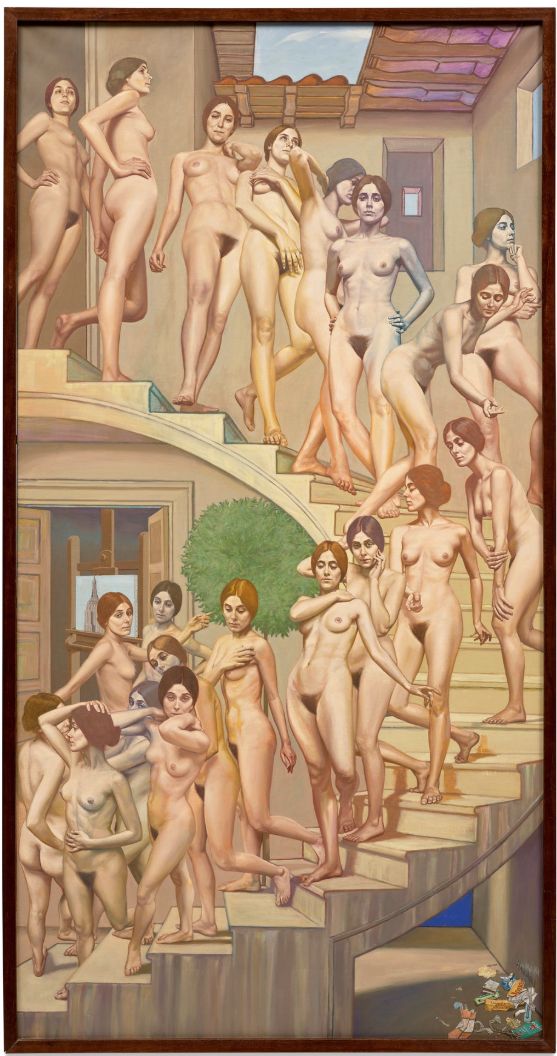
Lot 445, Hananiah Harari, Realistic Nudes Descending a Staircase. Presale estimate $12,000 - $18,000. Bidding reached $11,000, but that was not enough to meet an undisclosed reserve. It did not sell.
https://www.phillips.com/detail/hananiah-harari/230602
Richard Pettibone two takes on Bicycle Wheels
His final choices were two relatively recent works by West Coast American artist Richard Pettibone.
Pettibone, who died in August 2024, was introduced to Duchamp in the 1963 Pasadena exhibit. That show coincided with Warhol’s second show at Ferus Gallery in LA.
Pettibone had two pieces in the Phillips auction. “Over the years, Pettibone felt perfectly at liberty to replicate this work whenever he found a discarded bicycle wheel rim and fork, as he did to assemble the present example in 1998,” Naumann commented.
In the sale this was lot 463 https://www.phillips.com/detail/richard-pettibone/230543 It had a presale estimate of $25,000 - $30,000. Bidding reached $19,000, but did not meet an undisclosed reserve. This item passed (Did not sell).
A second Pettibone piece, lot 464, is a small painting also of the bicycle wheel caught his eye. www.phillips.com/detail/richard-pettibone/230551 Presale estimate was $18,000 - $25,000. Bidding went to $14,000, but did not reach an undisclosed reserve. This item passed (Did not sell).
View all auction results https://www.phillips.com/auction/NY030826
This was the first high end auction I’ve ever watched live streamed on my computer. I had no preconceived idea of what any of the items would bring, but after a quick review of our RBH records I thought some of the Phillips estimates were optimistic. It seemed to me that the opening bids were extremely low. Some things sold with multiple bids above the presale estimate, but many items sold for well below the low estimate, and quite a few did not sell at all.
The Phillips presentation was brisk and professional; it was all over in about 2 hours.
Bids were accepted in advance, on the phone and by buyers present in-house. Bids were received from around the world, with one of the most aggressive bidders coming from Spain.
The lots that generated the most interest that have not already been described are listed below. The price paid includes a hefty buyer's premium. Find all the results at https://www.phillips.com/auction/NY030826
420 Trocket, Traum $2,838, high estimate $2,000
427 Duchamp Chess Players 1911, $33,540, high estimate $30,000
432 Duchamp Sink Stopper, $7,095, high estimate $6,000
442 Duchamp Dada poster 1953, $6,192, high estimate $5,000
450 Catalog for the Pasadena Retrospective, $5,418, high estimate $5,000
454 Duchamp, Chess Player - etching 1966, $34,830 high estimate $20,000
468 Minotaure 1935, $2,193, high estimate $2,000
478 Man Ray Pin Up with real pins $11,610, high estimate $8,000
486 Duchamp, Rrose (sic) Sélavy, $2,064 high estimate $1,000
491 Levine, After Courbet 1-18, $33,540, high estimate $25,000
493 Kounellis, Sack, $18,060, high estimate $12.000
502 Obsatz photo Portrait Duchamp, $6,966, high estimate $1,200
When I spoke with Naumann again the morning after the sale his reaction was mixed - both happy and disappointed. “Some things did well, but some didn’t sell at all.” Overall he attributed it to the “dumbing down of the American clientele,” which he ascribed to “an indirect result of the internet. Duchamp and all of the artists in the auction are conceptual. (Today) people want to buy works of art that have a visual impact and that do not need to be interpreted and explained.”
A lot of what he offered is being returned. “I’m thrilled to have them back,” he said and appeared unconcerned with marketing. “With Duchamp you have to wait for the right client to come along.”
Francis M. Naumann, curator of the auction and author of the excellent catalog notes, is a resident of Yorktown Heights, NY. Reach him at [email protected]
NB: Still interested in Duchamp? See how things turned out on the 50th anniversary of the Armory show when Duchamp was in his 70s and is the featured artist in a West Coast retrospective. The documentary about the 1963 Duchamp exhibit in Pasadena, which coincided with Andy Warhol’s second show at Ferus Gallery in LA, is definitely worth watching. It's a little slow getting started, but gets better as it goes along. Watch it all the way to the end for a shot of the often referenced, but seldom seen nude photo of Eve Babitz playing chess with Duchamp. https://www.pbs.org/video/duchamp-comes-to-pasadena-7bkwpb/