Panckoucke’s Dictionary - Parlez-vous le Français de 1758?
- by Thibault Ehrengardt
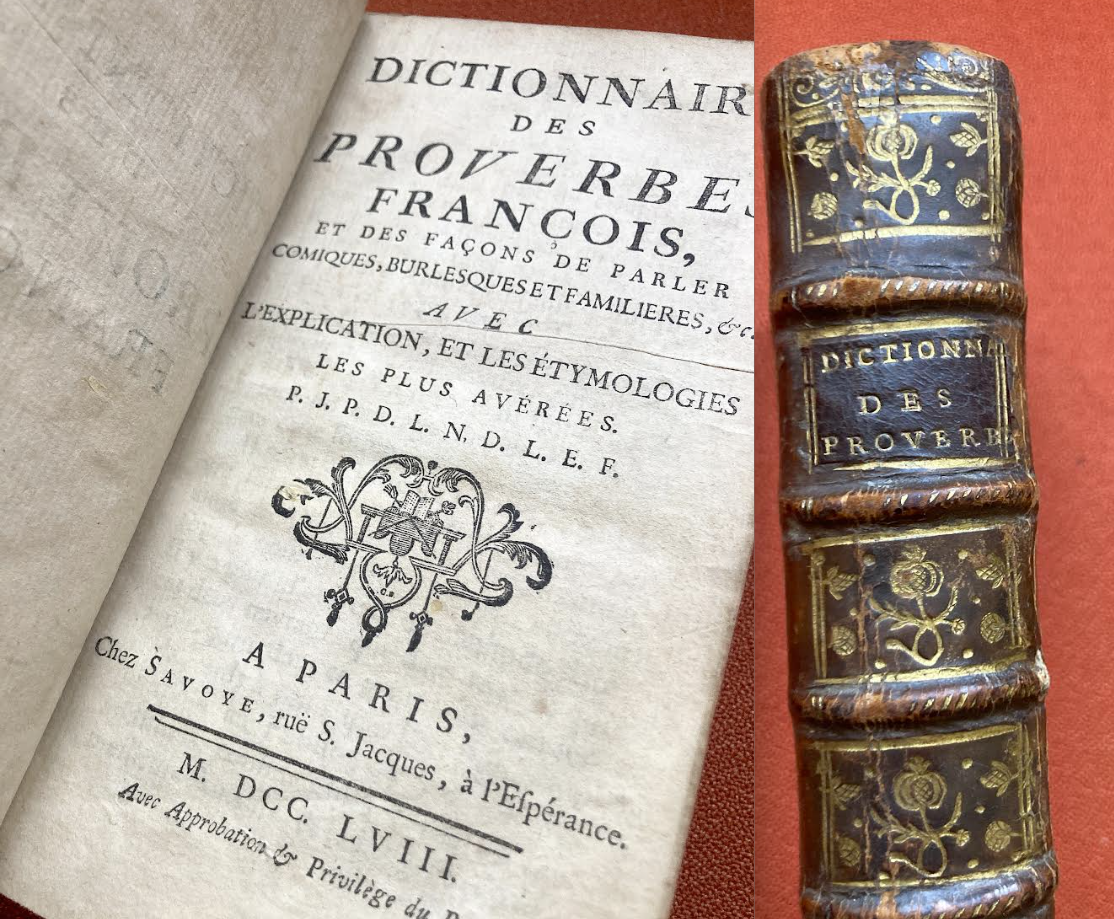
In France, we say of a man who speaks well that he speaks like a book (parle comme un livre). On the opposite, there’s a book that speaks like people did in 1758. The surprising Dictionaire des Proverbes françois (Paris, 1758)—dictionary of French Proverbs, lists hundreds of idioms from back in the days; some ring no bell whatsoever, while others are still in use today. The world is at war? Well, “amusons-nous à la moutarde” (let’s play with the mustard—let’s focus on light matters).
Panckoucke
“Our century being so fond of dictionaries,” the preface reads, “we thought this one might satisfy the curious.” It was put together by P.J.P.D.L.N.D.L.E.F., according to the title page—by André-Joseph Panckoucke (1703-1753), according to the Bibliothèque Nationale de France’s database. Panckoucke was a well-known printer based in Paris. His son Charles-Joseph later became one of the most important printers of the late 18th century.
On the endpapers of my copy of Dictionnaire des Proverbes..., a former owner, who was buried long ago, wrote: “This book belongs to Monsieur Maire; should someone find it, he would get a reward. Paris, rue du Faubourg Poissonnière, #1.” A moving testimony of the time when this book had enough value to deserve a reward—nowadays, a regular copy in good condition is worth but a few dozens euros: il faut prendre le temps comme il vient, as our book states, meaning “we must go with the times.”
Idioms
“L’occasion est chauve (the opportunity is bald, meaning it hardly occurs twice)” to have some fun, nowadays; so “prenons la balle au bond (let’s seize the ball as it bounces—or seize the time)” and let’s explain a few idioms contained in this playful book:
Banal (common): you say of a “coquette” that her heart is like a “four ban(n)al (common oven)”, where everyone can bake his bread. I had never heard this one, but I like it. Mercier tells us in his book about Paris, that it was very common for people to bring their meals to the bakery so the baker would bake it for them in his oven—the image seems much more relevant once you know that.
Deux (two): two good friends are “deux dans un bonnet (two under the same hat)”. This one is no more in use, but it’s very evocative.
Jeudi (Thursday): when something is never to happen, you say it might happen “la semaine des trois jeudis (the week with three Thursdays)” or “trois jours après jamais (three days after never)”. The first idiom is still current, although my grandmother was more familiar with it than my son—the latter is very uncommon.
Nues (skies): you say of a man that “il tombe des nues (falls from the skies)” when he’s very surprised—still in our everyday language.
Cochon (pig): two friends who get along very well are “camarades comme cochons (friends like pigs)”, and although “camarades” has been replaced by the term “copains (pals)”, every French person knows this one.
Arracher (to pull out): “arracher une dent à un avare (to pull a miser’s tooth)” means borrowing money from him. But it’s also well-known that “un avare pleure le pain qu’il mange (a miser cries over the very bread he eats)”. Hardly in use any more, but it’s always fun to mock a miser, isn’t it? As another obsolete idiom listed here reads: “chacun a sa besace, où il met les défauts d’autrui par devant, et les siens par derrière (in our shoulder bag, we usually store others’ flaws in the front pocket, and ours in the back pocket).”
Conclusion
The list goes on, and it’s very pleasant to discover obsolete idioms, as well as to find out which ones are still in use today. Of course, Mr Panckoucke ran a respectable business, and you’ll find no rude idiom here, although they were probably as numerous yesterday as they are today! But “on ne va pas en chier une pendule (let’s not shit a clock over that matter—let’s not make a fuss about it)”. It would be as effective as “pisser dans un violon (to piss in a violin—it would be useless)”.
Thibault Ehrengardt