How Many Books Do You Own?
- by Michael Stillman
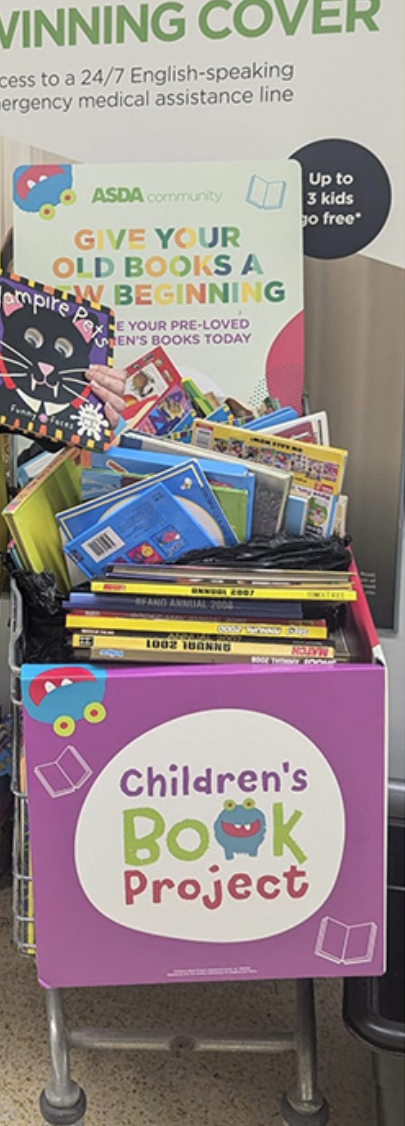
The Asda Children's Book Project collection cart.
How many books do you own? If you are a collector or a regular reader, undoubtedly more than the average person. If neither, you may still have some on your shelves anyway. Or, you may have none. A recent survey from the UK gives us a look inside the average British household.
Asda, a large British grocery chain that sells books, together with the Children's Book Project, recently conducted a survey of book ownership in the UK. What “The Books That Made Us” poll determined is that there are 283 million books resting on shelves in the UK. The percentage held by collectors is unknown, but probably not very large. Some are currently being read, but most probably fall in the category of read in the past or never read at all. For people concerned about the “Great Deaccession,” just think of what would happen if books that won't be read or won't be read again were dumped on the market. You don't want to as most would likely end up in the dump. Few of them are of much value.
How many does the average person own? The population of the UK is almost 70 million, so that comes to roughly four books per person. According to the Office of National Statistics, there are roughly 2.35 people in the typical household. Rounding off, that says that the average British household has ten books.
The Asda survey also concluded that 58% of the UK population is still holding onto their childhood books. The poll also found that 64% of adults in the UK said that their childhood reading habits shaped who they are today. An even larger 91% believe that reading or being read to was central to their childhood.
However, 88% of adults fear that children are missing out on the “magic” of reading. A separate study by Pew Research said 90% of teens use YouTube and 60% use TikTok. Snapchat and Instagram registered at roughly 50% each. Fading away is Facebook with only a third, down from 70% a decade ago. Adults consider social media the major “thief of time.” A majority, 57%, felt that way. They specifically cited YouTube and TikTok. The next largest time thief was video games cited by 30%. Lack of local library access was considered a problem by 69%. Aren't there libraries in the UK? Adults think that “reading for pleasure” should be treated on the same academic level as math or science.
Perhaps disappointing, the New York Times reported that many schools are no longer assigning full novels. The focus is more on preparation for standardized tests, so they are assigning excerpts and passages. The Times said twelfth grade reading scores are at a historic low with university professors reporting that students struggle with longer, complex texts.
Which children's books are most held onto by British adults? It's not the ones you might think, at least if you are an American. It's not the Harry Potter books. They are tied for second with 25% of the population, along with Alice's Adventures in Wonderland and Matilda. It's one that never really penetrated the American market, perhaps because its characters and adventures are more typically British. It's the Famous Five series by Enid Blyton that is held onto by 34% of British adults. Of course, the Harry Potter books were also written by a British author and take place in the UK, but still are enormously popular in the U.S. Perhaps the fact that the Famous Five books were written from the 1940s through early 1960s makes the difference. The internet and T.V. have melded cultures together as never before in the years since.
Credit needs to be given to Asda for conducting the poll and providing a place for people to leave their no-longer-read children's books in their many stores. The Children's Book Project distributes the books to economically disadvantaged children free. It gives them some of the opportunities to learn and prosper afforded those who grow up in more privileged circumstances. The Children's Book Project explains that it “is committed to closing the opportunity gap and lifting up our community by raising readers and ultimately paving the way for lifelong learning and literacy.”