A Unique Edgar Allan Poe 1861 Carte de Visite with Mathew Brady Association Generated Interest at November Auction
- by Susan Halas
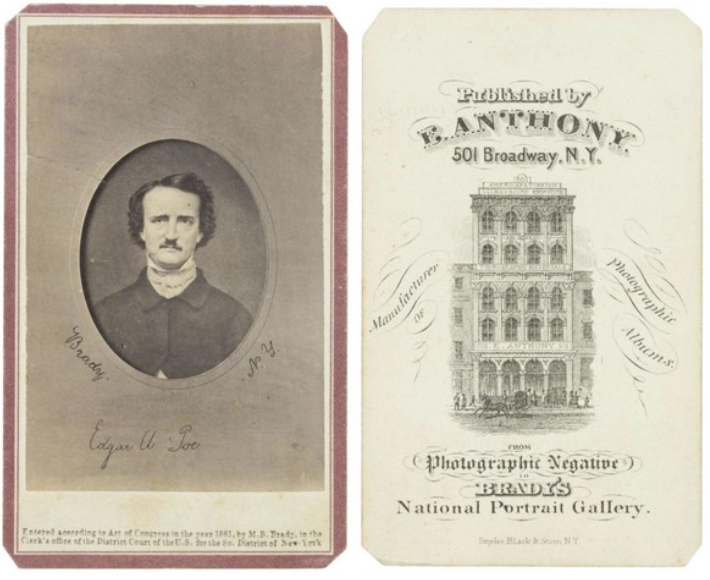
A unique Poe 1861 carte de visite with M. Brady association sells in recent auction. (Photo: University Archives)
A possibly unique carte de visite (CDV) portrait of Edgar Allan Poe from the work of Mathew B. Brady, the most prominent American photographer of the 19th century, was sold on Nov. 19 by University Archives (UA) for $20,000. The selling price was five times the presale high estimate of $4,000. A CDV is a French term for a small photographic image, usually a portrait, mounted on card stock. The term means “visiting card.” This type of photography was widely popular in the mid and late 19th century.
The card displaying an albumen photo of Poe measures 4 x 2.5.” According to the UA catalog notes, “Below the image, within the photographic plate, are the printed inscriptions: "Brady," "N.Y.," and "Edgar A. Poe," in delicate script. Along the lower edge of the mount is the imprint: "Entered according to Act of Congress in the year 1861, by M.B. Brady, in the Clerk's office of the District Court of the U.S. for the So. District of New-York." The reverse of the mount is printed with ornate typography and an engraved illustration of the multi-story E. Anthony studio located at 501 Broadway, New York, and includes the publishing line: "From Photographic Negative in Brady's National Portrait Gallery."
In a phone interview Lukas “Luke” Pascal, a UA expert who cataloged the piece mentioned that the auction house “has only handled one Poe CDV in our company's history. In 2017 UA sold a lesser copy with duller tones and visible wear for $4,375.” He said that the pre-sale estimate of value for the current sale was based on the price realized in the prior sale.
A long blog on the Historical Autographs Gallery site dated Sept. 2025 fleshes out many of the related details: “Edgar Allan Poe (1809 to 1849) played a defining role in shaping American literature. He is credited with inventing the detective fiction genre, elevating Gothic horror, and developing the short story into a respected literary form. His works such as The Raven, The Tell-Tale Heart, The Fall of the House of Usher, and The Cask of Amontillado are considered foundational texts.
“Poe’s life was marked by poverty, instability, and personal loss. He struggled with alcoholism, suffered the early death of his wife Virginia Clemm, and died under mysterious circumstances at the age of 40. Despite these challenges, his influence on global literature is profound. Writers as varied as Charles Baudelaire, H.P. Lovecraft, and Jorge Luis Borges drew on Poe’s aesthetic and psychological depth.
“By the time this CDV was issued in 1861, Poe had already become a posthumous icon. His reputation only grew in the years following his death, cementing him as one of America’s most mythologized literary figures.”
According to the blog, “The image, likely taken around 1848, a year before Poe's death, became one of the standard visual references for posthumous representations of Poe and was adopted by Mathew Brady, arguably the most significant American photographer of the 19th century, as part of his National Portrait Gallery initiative …
“Brady's National Portrait Gallery was an ambitious undertaking that aimed to document the most prominent American figures of the era through photography. First announced in the 1850s, it featured statesmen, authors, generals, and other luminaries, offering the American public an unprecedented visual record of their cultural heroes. The gallery was not a formal institution but rather a rotating exhibition and publishing effort, composed of original portraits and mass-produced photographic prints. By including Poe in this series, Brady solidified his place not only in American literary history but also in the emerging visual culture of the 19th century.
“The publisher E. Anthony was one of Brady’s key commercial partners. His studio at 501 Broadway was among the most prolific outlets for photographic prints, particularly CDVs, during the Civil War era.”
On the other hand, since Poe died in 1849 and this photo is dated 1861, there are skeptics who are dubious that Poe ever actually sat for this photo. Among the doubters are Michael Deas, author of The Portraits and Daguerreotypes of Edgar Allan Poe (1989), who is quoted in a post by the Poe Society of Baltimore: “One of the most widespread misconceptions concerning Poe portraiture is the belief that Poe once posed for the celebrated American photographer Mathew Brady (c.1823-1896). Brady himself fostered this myth, claiming not only to have photographed Poe but to have been present one evening when the poet, ‘in one of his moody moments,’ rattled off the first draft of The Raven. Neither claim has ever been substantiated.”
https://www.eapoe.org/papers/misc1921/deas205a.htm
Be that as it may, John Reznikoff, owner of UA, was also on the phone call, emphatically stated, “We’re pretty careful; we have the best descriptions in the historical market. We’ve been in business for 47 years. Our description never says he (Poe) sat for Brady.”
Both Reznikoff and Pascal went on to describe the business arrangement between publisher E. Anthony who distributed Brady’s work, making it clear that whether or not Poe actually sat for Brady, Poe’s portrait was in fact among Brady’s works, and that image was distributed by Anthony, even at a substantially later date.
Discussing the auction Reznikoff also said it took place over an extended period of time. The first twenty days bidding was online. Prospective buyers could bid on the internet at the UA site and could also use Invaluable or LiveAuctioneers. “The final day,” he said, “all bidding was live, and there were many bids. I saw the bids come through” he added, “and all of the people bidding understood what they were getting.”
He also clarified why, in a live bidding situation, it is better for the prospective buyer in a competitive situation to bid through the auction house offering the item rather than through a third party firm. For one thing the buyer’s premium may be lower, and perhaps more importantly, in the case of a tie, the preference is usually shown to the person bidding directly with the selling house and not an intermediary.
Link to auction record for RBH subscribers
https://rarebookhub.com/auction_lot_books/9329888?key=6f9ed697f57fdeccf9d381c9b594c4b4a505277a
You must be a subscriber and sign in for this link to work.